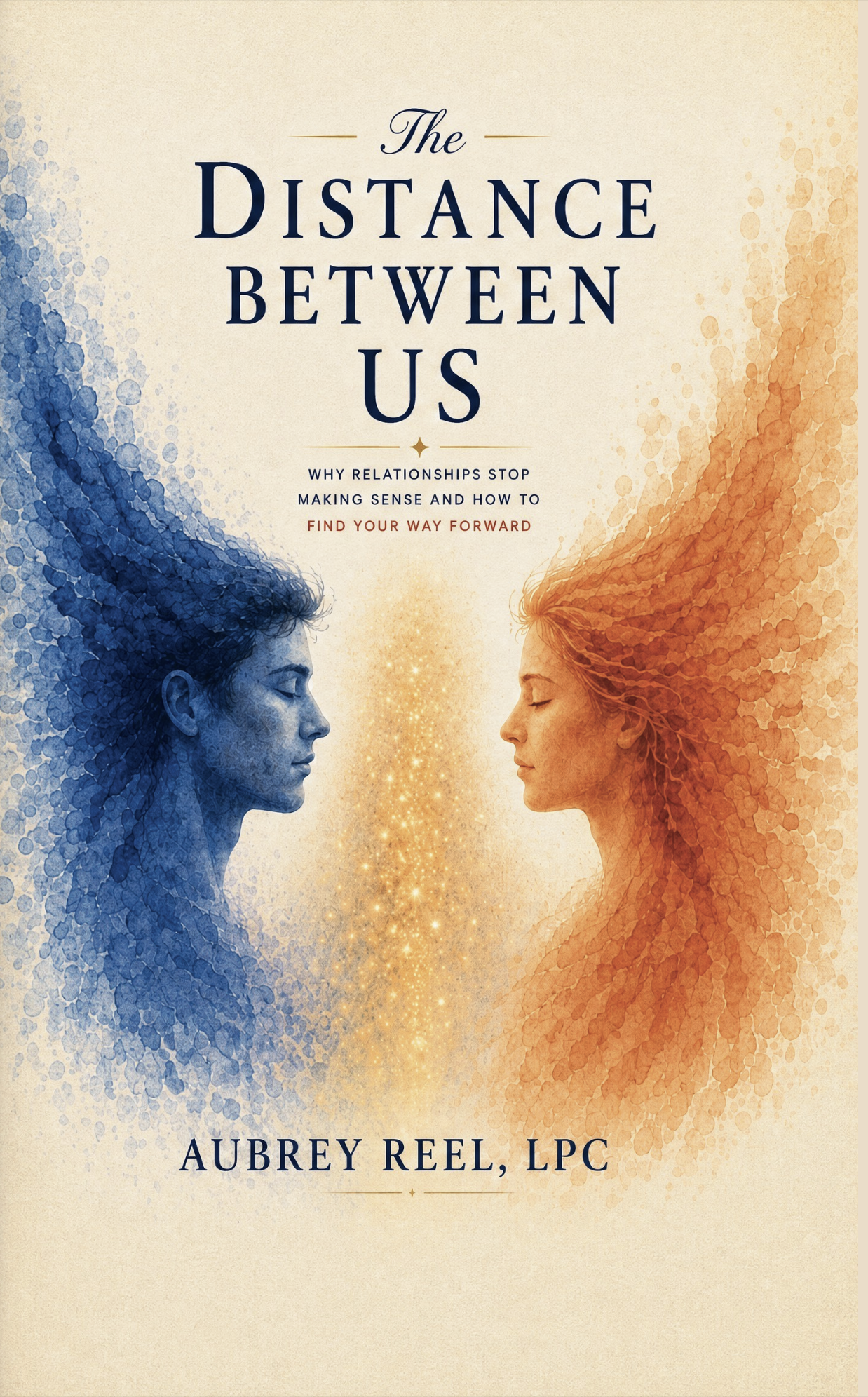
The Distance Between Us
Why Relationships Stop Making Sense and How to Find Your Way Forward
Aubrey Reel, LPC
Sometimes, what is most difficult about a relationship is not the conflict itself, but the inability to make sense of what keeps happening. Conversations remain unresolved, familiar patterns repeat despite our awareness of them, and we may find ourselves questioning our perceptions, our needs, or even who we are.
Drawing from attachment theory, trauma research, neurobiology, and clinical observation, The Distance Between Us introduces the Relational Capacity Model (RCM), a conceptual framework for understanding how our internal experiences shape what happens between us.
Rather than focusing solely on behavior, this book explores how identity, perception, meaning-making, and protective patterns influence our capacity to engage with ourselves and others. It examines why insight alone is not always enough, what makes repair possible, and why certain relational patterns persist despite our efforts to change them.
Written for individuals seeking a deeper understanding of themselves and their relationships, as well as clinicians interested in the processes underlying relational functioning, this book offers a way to recognize what is happening, discern what is possible, and move forward without losing connection with yourself.
Why I Wrote This Book
In my clinical work, and in my own life, I kept returning to questions that conversations about communication, attachment styles, and behavior couldn't fully answer.
Why can we understand our patterns clearly and still repeat them? Why can ordinary interactions leave us questioning our perceptions, our identities, and our relationships? Why is repair possible in some relationships and persistently out of reach in others?
Over time, I came to believe the answer lies beneath the surface, in the distance between what we want from a relationship and what we have the capacity to sustain.
The Distance Between Us is my attempt to map that distance. I didn't set out to create another system for categorizing people or assigning blame. I wanted a way to understand the processes that shape our relationships while preserving compassion, accountability, and personal agency.
Understanding why a pattern exists does not require us to excuse its impact. Understanding another person's limitations does not require us to abandon our own needs, values, or boundaries.
My hope is that this book offers clarity about ourselves, our relationships, and what relational change can and cannot do.