Role Capture vs. Gaslighting: Two Relational Injuries That Feel Similar but Are Not the Same
Why Role Capture and Gaslighting Get Confused
Many people come to therapy saying:
“I don’t know if I was gaslit or just slowly erased.”
“Nothing overt happened, but I don’t feel like myself anymore.”
“I became the problem, the caretaker, or the emotional one — and I don’t know how.”
That confusion makes sense.
Role capture and gaslighting can both leave you:
questioning your perceptions
minimizing your needs
shrinking emotionally
carrying responsibility that isn’t yours
But they are not the same dynamic, and distinguishing them matters because healing looks different for each.
What Is Role Capture?
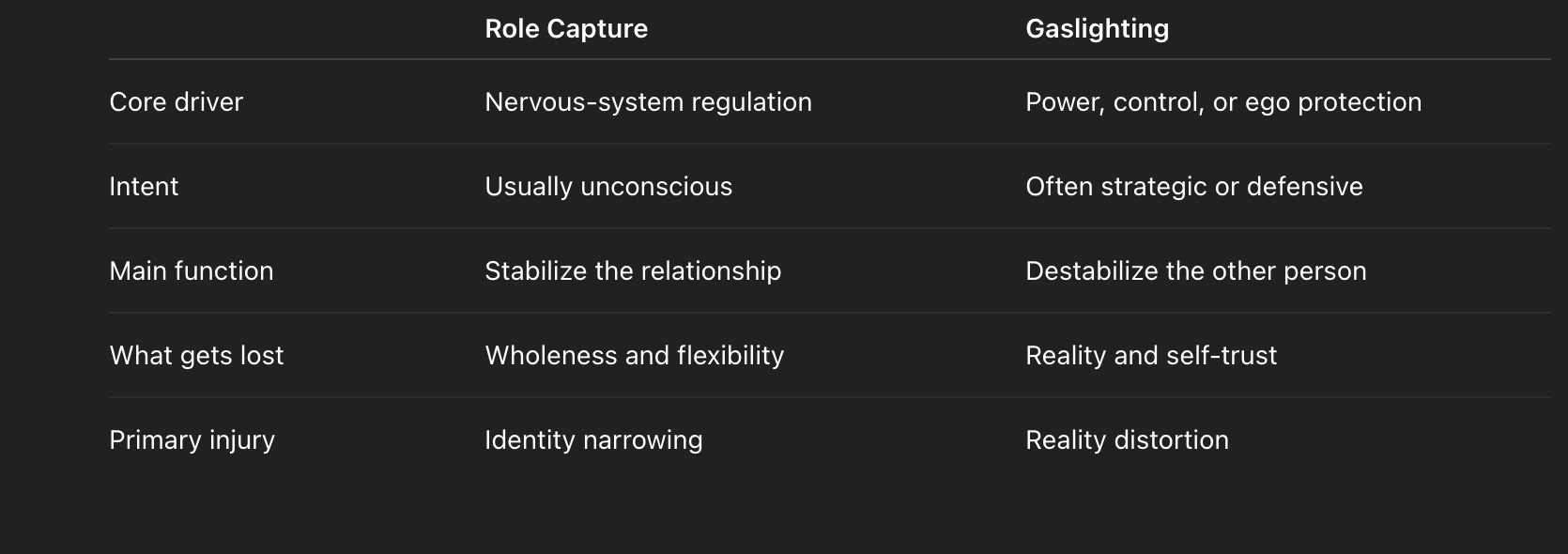
Role capture happens when a relationship unconsciously assigns you a function instead of relating to you as a whole person.
You become:
the caretaker
the regulator
the “too sensitive” one
the strong one
the peacekeeper
the problem
This isn’t usually malicious.It emerges when one nervous system has more capacity than the other, and the relationship stabilizes by narrowing who each person is allowed to be. Role capture is about relational adaptation.
What Is Gaslighting?
Gaslighting is a form of psychological manipulation where one person distorts, denies, or rewrites reality in order to maintain power, control, or self-protection.
It involves:
denying events or statements
minimizing or invalidating emotions
contradicting your lived experience
making you feel irrational or unstable
subtly positioning themselves as the authority on reality
Gaslighting is about distorting truth to destabilize you. It may be intentional or unconscious but the effect is the same: erosion of self-trust.
Core Difference at the Root
How Each Feels in the Body
Role Capture Feels Like:
chronic fatigue
tight chest when you want to speak freely
guilt when you rest or stop overfunctioning
a sense of “I can’t change or this will fall apart”
self-editing rather than self-doubt
Your body says: “I have to stay this way to stay connected.”
Gaslighting Feels Like:
dizziness, fog, or dissociation
stomach drop after conversations
racing thoughts trying to “figure it out”
confusion that doesn’t resolve with reflection
loss of trust in your own memory or feelings
Your body says: “Something is wrong, but I’m not allowed to name it.”
How They Can Overlap
Here’s where it gets tricky: role capture can exist without gaslighting, but gaslighting often uses role capture to sustain itself.
For example:
You’re assigned the role of “the emotional one.”
When you express hurt, it’s dismissed as overreaction.
Over time, your emotions become the problem, not the behavior.
That’s no longer just role capture — that’s gaslighting layered on top of role capture.
Key Distinguishing Questions
Ask yourself:
If it’s role capture:
Do they rely on me staying this way to feel stable?
Do they become uncomfortable (not cruel) when I change?
Is my role rewarded with approval and punished with withdrawal?
Do I feel responsible for the system, not insane?
If it’s gaslighting:
Do they deny things I clearly remember?
Do they frame my feelings as irrational or invented?
Do I leave interactions more confused than before?
Do I feel like I’m losing my grip on reality?
Healing Looks Different
Healing from Role Capture
Involves:
expanding capacity on both sides (if possible)
reclaiming disowned parts of self
tolerating guilt or anxiety as roles shift
learning that connection doesn’t require self-erasure
The work is differentiation, not confrontation.
Healing from Gaslighting
Involves:
restoring trust in your perceptions
naming reality clearly and privately
seeking external validation and reflection
creating distance from the manipulative dynamic
rebuilding your internal authority
The work is re-anchoring reality, not negotiation.
A Crucial Truth
You can step out of role capture with someone who is willing to grow. You cannot heal gaslighting inside the relationship if the other person refuses accountability. One dynamic asks for mutual expansion. The other requires self-protection and clarity.
Case Study 1: The Caretaker
Role Capture Without Gaslighting
Background
Hannah was married to a partner who struggled with anxiety and emotional overwhelm. Hannah was naturally attuned, organized, and calm under pressure.
Role Capture
Over time, Hannah became the caretaker and emotional regulator.
She soothed conflict, managed logistics, and absorbed emotional stress so her partner wouldn’t spiral.
Her partner often said:
“I don’t know what I’d do without you.”
“You’re so much better at handling emotions.”
Somatic Experience
Shoulder tension
Chronic fatigue
Feeling “on” all the time
Guilt when imagining doing less
What Makes This Role Capture (Not Gaslighting)
Hannah’s perceptions were never denied
Her feelings were acknowledged, even if not fully met
Her partner didn’t rewrite reality — he relied on her stability
Shift
In therapy, Hannah stopped over-functioning and allowed her partner to feel discomfort.
Outcome
The relationship either had to rebalance — or reveal that it couldn’t survive without Hannah’s self-erasure. Hannah regained energy and emotional range.
Case Study 2: The Caretaker
Role Capture WITH Gaslighting
Background
Sophie played a similar caretaker role in her relationship — but with a key difference. When she expressed exhaustion, her partner responded with calm dismissal.
Gaslighting Layer
He said things like:
“You’re choosing to do all this.”
“No one asked you to overextend.”
“You like being the martyr.”
Somatic Experience
Chest tightness when asking for help
Sudden self-doubt
Emotional collapse after conversations
Feeling ashamed for being tired
What Changed
Sophie wasn’t just over-functioning — her reality was being reframed so the burden appeared self-inflicted.
Outcome
Healing required not rebalancing the relationship — but restoring Sophie’s trust in her own experience. Distance, not negotiation, was the repair.
Case Study 3: The “Sensitive One”
Role Capture Without Gaslighting
Background
Aaron was more emotionally expressive than his partner. He often initiated conversations about connection.
Role Capture
Aaron became the emotional one. His partner listened but didn’t reciprocate emotionally.
Somatic Experience
Throat tightness
Feeling exposed
Longing rather than confusion
What Makes This Role Capture
His partner didn’t deny his feelings
Aaron felt unmet, not crazy
The pain was about imbalance, not reality distortion
Outcome
Aaron learned to ask for reciprocity and to decide whether the relationship could meet him.
Case Study 4: The “Sensitive One”
Role Capture WITH Gaslighting
Background
Liam played a similar role but his partner reframed his emotions as flaws.
Gaslighting Layer
She said:
“You’re too sensitive.”
“You always overreact.”
“You’re exhausting to talk to.”
Somatic Experience
Foggy thinking
Freezing mid-sentence
Loss of emotional language
Self-silencing
What Changed
Liam stopped bringing things up not because he felt heard, but because he felt wrong.
Outcome
Therapy focused on separating emotional expression from defectiveness. Liam’s healing required reclaiming his right to feel, not improving communication.
Case Study 5: The Peacekeeper
Role Capture Without Gaslighting
Background
Nina avoided conflict because her partner became visibly dysregulated during disagreements.
Role Capture
She became the peacekeeper, smoothing tension and avoiding hard conversations.
Somatic Experience
Tight jaw
Anxiety before speaking up
Relief when things stayed calm
Key Marker
When Nina did express anger, her partner acknowledged it even if poorly.
Outcome
The work was learning that Nina didn’t have to manage the emotional climate alone.
Case Study 6: The Peacekeeper
Role Capture WITH Gaslighting
Background
Laura also avoided conflict but when she tried to speak up, her partner reframed her concerns as aggression.
Gaslighting Layer
He said:
“Why are you attacking me?”
“You’re creating problems.”
“You’re imagining conflict.”
Somatic Experience
Sudden guilt
Shaking hands
Collapse into apology
Loss of confidence mid-conversation
Outcome
Laura’s nervous system learned that honesty was dangerous. Healing required external validation and distance, not further attempts at “better communication.”
Case Study 7: The Strong One
Role Capture Turning Into Gaslighting
Background
Marcus was praised as “so solid” and “unshakeable.” He never needed much.
Role Capture
He became the strong one — until he finally admitted he was struggling.
Gaslighting Layer
His partner responded with:
“You’re not like this.”
“This isn’t you.”
“You’re being dramatic.”
Somatic Experience
Emotional collapse
Shame
Confusion about identity
Desire to retreat back into strength
Outcome
Marcus learned that the relationship only supported one version of him. Healing required reclaiming emotional range — even if the relationship couldn’t tolerate it.
Closing Reflection
Role capture quietly narrows who you’re allowed to be. Gaslighting quietly tells you that who you are is wrong. Both disconnect you from yourself — but only one actively distorts reality.
Healing begins when you stop asking:
“What’s wrong with me?”
and start asking:
“What has this relationship required me to become?”
Your body already knows the answer.
