Role Capture in Relationships: When You Become Who the Relationship Needs You to Be
What Is Role Capture?
Role capture occurs when a relationship unconsciously assigns you a specific function ,and over time, your identity, behavior, and emotional range shrink to fit that role.
You’re no longer relating as a whole person. You’re relating as:
the caretaker
the stabilizer
the emotional one
the rational one
the difficult one
the peacemaker
the strong one
the needy one
At first, the role feels useful — even loving. Eventually, it feels confining. Role capture isn’t about bad intentions.It’s about nervous systems organizing around safety rather than mutuality.
How Role Capture Forms
Role capture usually emerges when:
one partner has unresolved trauma or limited emotional capacity
one partner overfunctions to keep connection intact
emotional expression is unevenly tolerated
conflict or vulnerability feels unsafe for one person
The system adapts.
One person learns:
“If I stay calm / helpful / quiet / strong, this works.”
The other learns:
“If they handle it, I don’t have to.”
Neither person consciously agrees to this arrangement — it simply stabilizes the relationship temporarily.
Common Role-Captured Positions
1. The Caretaker / Regulator
You manage emotions, logistics, conflict, and repair.
You’re praised for being “so understanding.”
You feel exhausted and unseen.
2. The Problem / Sensitive One
You’re the one who brings up concerns.
Your emotions are framed as the issue.
You begin doubting your perceptions.
3. The Strong / Self-Sufficient One
You don’t need much.
You don’t fall apart.
You don’t ask.
And no one notices when you’re lonely.
4. The Peacekeeper
You smooth things over.
You swallow your truth to keep harmony.
Resentment quietly accumulates in your body.
5. The Dependent / Incompetent One
You’re subtly positioned as unable to cope alone. Someone else decides what’s “best” for you. Your agency erodes.
Roles differ, but the outcome is the same: one person’s wholeness gets sacrificed for relational stability.
What Role Capture Feels Like in the Body
Role capture is often somatically obvious before it’s cognitively clear.
You may notice:
tightness in the chest or throat when you want to speak honestly
fatigue that doesn’t lift with rest
a collapsing posture around the other person
anxiety when you imagine acting differently
guilt at the thought of disappointing them
a sense of “shrinking” or self-editing
Your body knows you’re being asked to stay predictable, not authentic.
Why Role Capture Is So Hard to Leave
Because the role:
once kept you connected
once made you feel needed or safe
often mirrors childhood survival strategies
Leaving the role doesn’t just threaten the relationship — it threatens your identity.
Many people fear:
“If I stop being this, I’ll be abandoned.”
“If I change, they’ll fall apart.”
“If I step out, I’ll become the villain.”
That fear is not immaturity.
It’s attachment memory.
Role Capture vs. Healthy Complementarity
All relationships have some division of labor. Role capture happens when roles harden and emotional flexibility disappears.
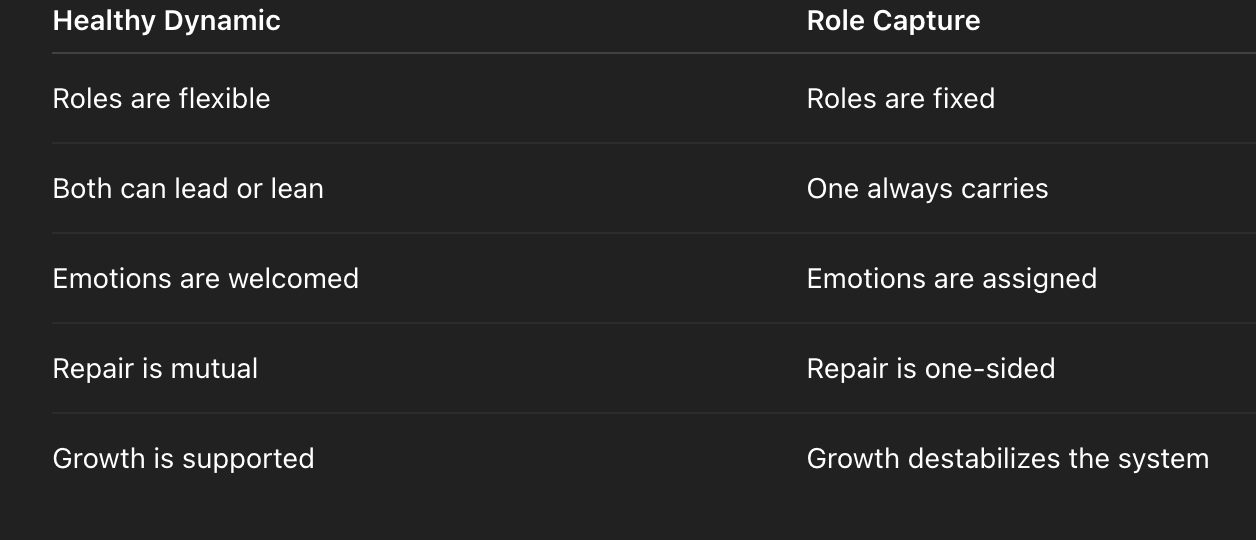
If becoming more yourself threatens the relationship, something is off.
How Role Capture Is Maintained
Often through subtle feedback:
praise when you stay in role
withdrawal when you don’t
confusion or distress when you change
guilt when you assert needs
accusations of “you’ve changed”
These aren’t always manipulative. They’re often unconscious attempts to restore equilibrium, but equilibrium isn’t the same as intimacy.
Stepping Out of Role Capture (Without Carrying Their Emotions)
1. Name the Pattern Internally
You don’t have to announce it yet.
Just notice:
“I’m being pulled into the role again.”
Awareness loosens the grip.
2. Regulate Before You Differentiate
Don’t exit the role in a spike of anger or panic.
Ground your body first.
Role capture dissolves through steadiness, not rebellion.
3. Change One Small Behavior
You don’t need a speech.
Try:
not fixing immediately
pausing before reassuring
expressing one honest feeling
letting discomfort exist
Small deviations retrain the system.
4. Allow the Other Person to Feel
This is the hardest part.
Their discomfort does not mean you’re doing harm.
It means the system is adjusting.
5. See What Happens
Healthy relationships adapt.
Unhealthy ones escalate pressure to return to role.
That information matters.
Role Capture in Therapy
In therapy, especially Emotionally Focused Therapy (EFT) and somatic work, role capture is gently exposed by slowing the interaction down.
Clients learn:
which parts of them are allowed vs. restricted
how their body braces to maintain role
how to tolerate guilt, anxiety, or grief without reverting
how to reclaim disowned needs and emotions
Healing doesn’t mean flipping roles. It means integrating the parts that were exiled.
Case Study 1: The Emotional Regulator
(Romantic Relationship – Caretaker Role)
Background
Lena entered therapy feeling exhausted, resentful, and emotionally flat. She described her partner, Mark, as “sensitive and overwhelmed.” She was the one who soothed conflicts, anticipated his moods, and kept the relationship emotionally afloat.
Role Capture
Without discussion, Lena became the emotional regulator.
She learned that if she stayed calm, validating, and flexible, the relationship felt stable. When she expressed her own hurt, Mark shut down or became anxious, so she stopped bringing things up.
Somatic Experience
Tight chest when wanting to speak honestly
Fatigue that didn’t resolve with rest
Guilt when imagining “doing less”
A sense of carrying weight in her shoulders
Maintaining Pattern
Mark praised her for being “so understanding.”
When Lena withdrew emotionally, Mark became distressed, reinforcing her role as stabilizer.
Therapeutic Shift
In therapy, Lena practiced not immediately regulating Mark’s emotions. She allowed his discomfort to exist without rescuing. The anxiety spiked — but then settled.
Outcome
Mark eventually had to develop his own emotional regulation. The relationship either had to evolve — or reveal its limits. Lena reclaimed emotional reciprocity.
Case Study 2: The “Too Sensitive” One
(Role Capture + Subtle Gaslighting)
Background
Daniel came to therapy unsure if he was “overreacting” in his marriage. His wife often said things like, “You always take things personally,” or “You’re reading into it.”
Role Capture
Daniel was unconsciously assigned the role of the emotional problem.
Whenever conflict arose, the focus shifted to his feelings rather than the behavior that triggered them.
Somatic Experience
Stomach drop during conversations
Foggy confusion after disagreements
Self-doubt instead of anger
Difficulty tracking what actually happened
Maintaining Pattern
His wife remained calm and logical. Daniel became emotional — reinforcing the narrative that he was the issue.
Therapeutic Shift
Therapy focused on reality anchoring. Daniel began validating his internal experience before discussing it with his partner.
Outcome
Once Daniel stopped absorbing the role, the dynamic became visible. Either the relationship could tolerate shared accountability — or it couldn’t. Daniel regained clarity and self-trust.
Case Study 3: The Strong One
(High-Functioning Role Capture)
Background
Maria was praised by everyone as “the rock.” She never asked for help, rarely expressed distress, and prided herself on independence. Inside, she felt lonely and unseen.
Role Capture
Maria became the strong, self-sufficient one in her marriage. Her partner unconsciously relied on her stability and never checked in emotionally — because Maria never “needed” anything.
Somatic Experience
Emotional numbness
A hollow feeling in the chest
Difficulty identifying her own needs
Anxiety when imagining vulnerability
Maintaining Pattern
Her partner admired her competence. When Maria tried to share vulnerability, he became uncomfortable and quickly changed the subject.
Therapeutic Shift
Maria practiced naming needs without minimizing them. She tolerated the discomfort of being seen.
Outcome
Her partner had to either grow into emotional responsiveness — or remain emotionally distant. Maria learned that strength without softness isn’t connection.
Case Study 4: The Peacekeeper
(Conflict-Avoidant Role Capture)
Background
Evan grew up in a volatile household and learned early that conflict meant danger. In his adult relationship, he avoided disagreement at all costs.
Role Capture
Evan became the peacekeeper.
He smoothed tensions, apologized quickly, and suppressed his own frustration to keep things calm.
Somatic Experience
Throat tightness when wanting to disagree
Shallow breathing during conflict
Anxiety before difficult conversations
Jaw clenching
Maintaining Pattern
His partner relied on Evan to de-escalate. When Evan finally expressed anger, his partner reacted strongly — reinforcing Evan’s fear that honesty caused harm.
Therapeutic Shift
Evan practiced staying present through conflict instead of fawning. He learned that tension doesn’t equal catastrophe.
Outcome
Conflict became more honest and less explosive. Evan reclaimed his voice without abandoning the relationship.
Case Study 5: Parent–Child Role Capture
(Adult Child as Emotional Caretaker)
Background
Morgan felt intense guilt whenever she set boundaries with her mother. Her mother confided in her about loneliness, finances, and emotional pain.
Role Capture
Morgan was captured into the role of emotional spouse — regulating her mother’s feelings and postponing her own independence.
Somatic Experience
Chest heaviness when ignoring texts
Anxiety before phone calls
Guilt mixed with resentment
Feeling “pulled back” into childhood
Maintaining Pattern
Her mother framed closeness as love and distance as abandonment.
Therapeutic Shift
Morgan practiced differentiation — caring without carrying. She reduced emotional disclosure and allowed her mother to feel disappointed.
Outcome
Morgan reclaimed adulthood. Her mother had to grieve the loss of emotional fusion or escalate attempts to restore it. Either way, Morganl was no longer available for role capture.
Case Study 6: Workplace Role Capture
(The Fixer)
Background
Tom was the employee everyone relied on. He fixed mistakes, stayed late, and absorbed pressure so others wouldn’t have to.
Role Capture
Tom became the organizational regulator. His competence masked systemic dysfunction.
Somatic Experience
Chronic stress
Tension headaches
Irritability outside of work
Difficulty resting
Maintaining Pattern
Praise and dependence replaced structural change.
Therapeutic Shift
Tom began setting limits and allowing problems to surface without fixing them.
Outcome
The organization had to address its issues or lose Tom. His health improved once he stepped out of the role.
Closing Reflection
Role capture isn’t a failure of love. It’s a survival adaptation that stayed too long.
You were never meant to be:
the container for someone else’s emotions
the problem to be managed
the strength that never rests
You were meant to be relationally alive — complex, responsive, and real. When you step out of role capture, you may lose certainty, but you regain something far more important: yourself.
