When Love Feels Intense but Unsafe: How Trauma Bonds Are Formed (and How They Heal)
Many people come into therapy saying some version of: “I’ve never felt a connection like this… but I’ve never felt so anxious, confused, or small either.”
They’re not weak. They’re not addicted to drama. They are bonded to a nervous-system loop that looks like love but feels like danger. This is called a trauma bond. Trauma bonds form when emotional closeness is present, but safety and responsibility are not. The connection feels profound, but the relationship never becomes stable or secure. To understand why this happens, it helps to look at relationships through four core pillars.
The Four Pillars of a Healthy Bond
Every secure relationship needs four things:
1. Knowing
Being emotionally seen, understood, and welcomed as you are.
2. Bonding
The felt sense of warmth, attunement, and “we are connected.”
3. Attachment
Emotional safety that allows closeness without panic and distance without collapse.
4. Responsibility
The ability to take ownership, repair, stay present, and protect the relationship when something hurts.
Trauma bonds form when the first two pillars are strong but the last two are missing. You get intimacy without safety.
What Trauma Bonding Feels Like in the Body
People in trauma bonds often describe:
Feeling euphoric when it’s good and devastated when it’s not
Waiting for texts, moods, or signals
Replaying conversations
Feeling alive with the person but anxious afterward
Feeling ashamed for wanting more
Not feeling free to ask for clarity
That isn’t romance — it’s a nervous system in survival mode.
Common Trauma-Bond Patterns
These patterns show up again and again in therapy. Here are two composite case examples that illustrate how trauma bonds can look very different — but feel just as painful.
(Names are fictional.)
Case 1: “Laura & Mark” — The Role-Based Marriage
Laura came to therapy exhausted, numb, and quietly grieving her marriage to Mark.
On the surface, it looked stable:
They lived together
Raised children
Shared responsibilities
But emotionally, something was missing.
Knowing
Mark knew Laura’s schedule, her work, her parenting but not her inner world. When Laura shared feelings, he experienced it as:
Criticism
A threat
Something to be fixed
So she learned:
“Being agreeable keeps the peace. Being real causes conflict.”
Bonding
Laura bonded to:
The marriage
The family
The future
Mark bonded to:
How Laura regulated him
How she reduced his anxiety
How she didn’t need much
He wasn’t bonded to her — he was bonded to her function.
Attachment
Laura’s independence triggered Mark’s panic. Her boundaries felt like abandonment. So he clung. She managed. Neither felt safe.
Responsibility
Laura carried the relationship:
Tracking emotions
Soothing conflict
Adjusting herself
Repairing everything
Mark reacted, blamed, or withdrew. This relationship lasted but it hollowed Laura out.
Case 2: “Maya & Elias” — The Intense Connection That Vanished
Maya met Elias after a long period of loneliness. What they shared felt extraordinary.
Knowing
They saw each other deeply:
Trauma
History
Hopes
Fears
Longing
Maya felt recognized.
Bonding
Their emotional and spiritual connection was electric. There was meaning, memory, imagination. But here was the fracture: Maya bonded to a relationship.
Elias bonded to an experience.
Attachment
As closeness grew, Elias’s nervous system panicked.
Intimacy → fear
Needs → overwhelm
Clarity → shutdown
So he pulled away.
Maya stayed emotionally oriented to him. He disappeared, emotionally first and then physically.
Responsibility
When Maya said:
“This hurts.”
“I need clarity.”
“I can’t live in this ambiguity.”
Elias couldn’t stay. He didn’t step forward. He went quiet. Maya was left holding the truth and the grief alone.
This is the trauma bond pattern: Deep love without emotional safety.
Case 3: “Elena & Victor” — The Covert Narcissist Bond
Elena came into therapy feeling disoriented, ashamed, and deeply confused. She kept saying: “He was so kind… but I don’t know why I feel so small now.”
Victor never yelled. He didn’t cheat. He didn’t explode. Instead, he made Elena slowly disappear inside the relationship.
1. Knowing
At first, Victor was intensely attentive.
He:
asked deep questions
remembered details
mirrored her values
admired her insight
Elena felt deeply seen.
But over time, the knowing became selective.
He:
noticed her strengths when they benefited him
ignored her needs when they didn’t
subtly corrected her memory, feelings, or perception
She began to think:
“Maybe I’m too sensitive. Maybe I misunderstood.”
This is gaslighting through gentleness.
2. Bonding
Victor created a powerful emotional bond through:
vulnerability
quiet intensity
shared pain
“only you understand me” energy
Elena bonded deeply. Victor bonded to:
being centered
being needed
being special in her eyes
The bond felt intimate but it was not mutual.
3. Attachment
Elena grew attached to Victor.
Victor stayed emotionally unavailable. When Elena needed:
reassurance
clarity
emotional presence
Victor responded with:
confusion
hurt feelings
withdrawal
or subtle blame
So Elena learned:
“My needs hurt him. I should stop having them.”
That is not attachment — that is nervous-system submission.
4. Responsibility
This is where covert narcissism becomes visible.
When something hurt Elena:
Victor felt misunderstood
Victor felt attacked
Victor felt victimized
So Elena ended up:
apologizing
explaining
soothing
minimizing herself
Victor never repaired. He only needed to be reassured. That creates the deepest trauma bond of all:
You become responsible for protecting the person who is hurting you.
What This Pattern Feels Like in the Body
People bonded to covert narcissists often report:
chronic anxiety
brain fog
loss of confidence
feeling like they’re “too much”
walking on eggshells
self-doubt about their own reality
Not because they are unstable but because their nervous system is being slowly destabilized.
Why This Bond Is So Hard to Leave
Covert narcissistic bonds don’t look abusive.
They look:
quiet
sensitive
wounded
misunderstood
But the emotional pattern is:
You give. They take. You shrink. They stay centered.
That is not love. That is relational starvation.
Case 4: “Maya & Luke” — The Grandiose Narcissist Bond
Maya described Luke as: “Charismatic, magnetic, brilliant… and somehow always the main character.” At first, he felt intoxicating.
1. Knowing
Luke was fascinated by Maya — but not in a curious way.
He knew:
her dreams
her vulnerabilities
her history
But he used them to:
impress her
mirror her
position himself as superior
She felt special because he chose her but she was never actually known. She was a reflection.
2. Bonding
The bond was intense, fast, dramatic.
Luke created:
grand gestures
big promises
emotional highs
sexual chemistry
Maya bonded deeply.
Luke bonded to:
being admired
being desired
being central
The bond was fueled by dopamine, not safety.
3. Attachment
Luke wanted Maya close but only on his terms.
When Maya needed:
reassurance
consistency
mutuality
Luke felt:
bored
irritated
trapped
So he alternated between:
pulling her close
pushing her away
This kept Maya chasing. That is addiction, not attachment.
4. Responsibility
Luke did not apologize.
He:
reframed
justified
blamed
minimized
If Maya was hurt, it was because she was:
too sensitive
too needy
too emotional
So Maya learned:
“I have to earn love by being less.”
That is trauma bonding.
What This Bond Feels Like in the Body
People bonded to grandiose narcissists feel:
euphoric highs
crushing lows
craving
obsession
fear of being replaced
self-comparison
The body stays in dopamine-driven survival mode.
Case 5: “Jonah & Claire” — The Sadistic Trauma Bond
This bond is rarer — but devastating. Jonah loved Claire but Claire enjoyed his pain. Not overtly. Not always consciously. But consistently.
1. Knowing
Claire knew Jonah deeply.
She knew:
his fears
his wounds
what hurt him most
And she used that knowledge:
during fights
during silence
during withdrawal
The knowing became a weapon.
2. Bonding
The bond formed through:
intensity
vulnerability
cycles of closeness and cruelty
Jonah bonded through pain. Claire bonded through power. The nervous system learned:
“Love and hurt go together.”
That is the deepest trauma loop.
3. Attachment
Jonah became attached.
Claire controlled the attachment by:
withholding
humiliating
destabilizing
then offering crumbs of connection
This created:
hypervigilance
fawning
terror of abandonment
The attachment was built on fear, not love.
4. Responsibility
Claire never repaired.
She:
denied
mocked
justified
blamed Jonah for being hurt
So Jonah learned:
“My pain is wrong.”
That is psychological injury, not conflict.
What Sadistic Bonds Feel Like in the Body
Survivors often feel:
dread
freeze
dissociation
collapse
loss of self
panic when thinking of leaving
Because the nervous system is trapped between: attachment and threat. That is the core of trauma bonding.
The Through-Line Across All These Bonds
What creates trauma bonds is not personality. It is this equation:
Bonding + Knowing – Responsibility = Nervous-System Entrapment
When attachment and accountability never arrive, the body keeps waiting. That waiting is what hurts.
SECURE BOND REFERENCE
“How healthy love actually feels in the body”
Most people coming out of trauma bonds don’t know what they’re aiming for — they only know what hurts.
This gives them a somatic compass.
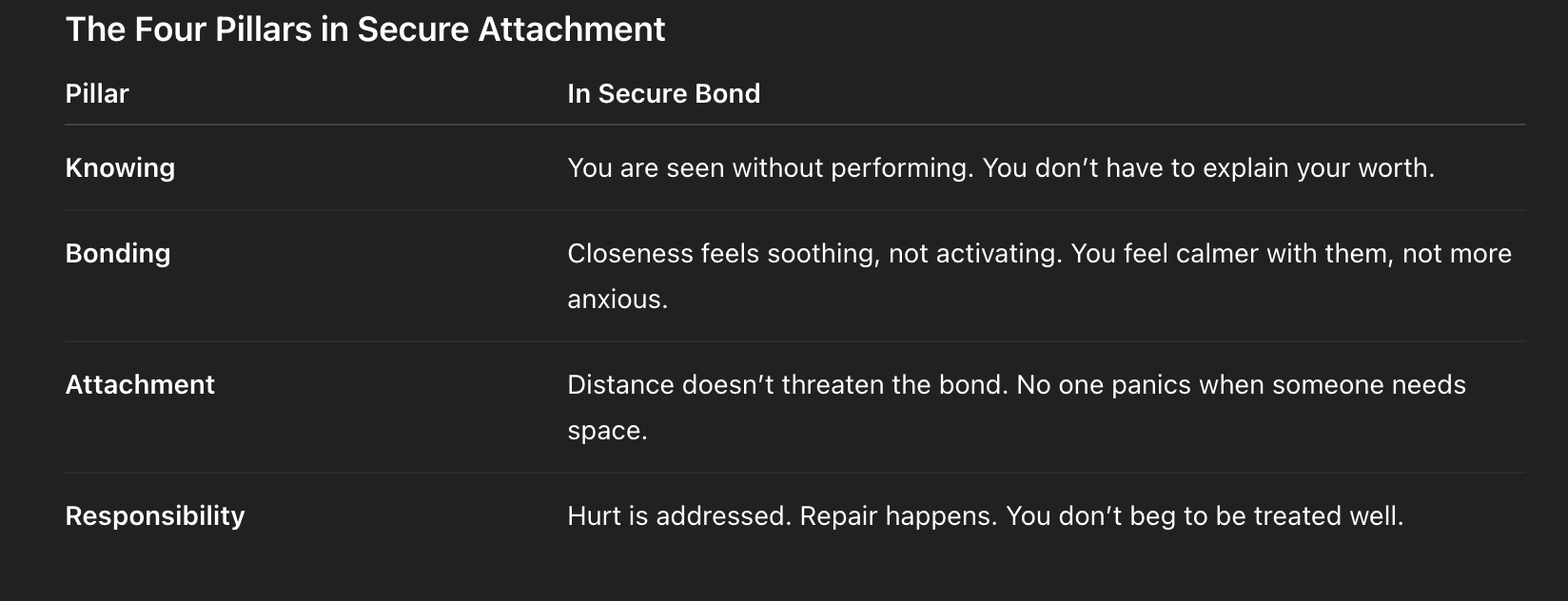
What Secure Love Feels Like in the Body
You don’t feel:
hyper-focused
obsessed
afraid to speak
desperate to be chosen
You feel:
grounded
warm
steady
relaxed
oriented toward your own life
Secure love doesn’t hijack your nervous system, it co-regulates it. If a relationship makes you:
sleep better
eat better
think more clearly
feel more yourself
That is safety. Not boredom. Not lack of chemistry. Safety.
THE SOMATIC EXIT MAP
“How to unhook from a trauma bond in real time”
Trauma bonds live in the body, not the mind. So they must be exited through the nervous system. Here is how.
Step 1 — Name the Activation
The moment you feel:
urge to text
craving
panic
longing
shame
Say:
“This is attachment activation, not intuition.”
This interrupts the trauma story.
Step 2 — Locate It in the Body
Ask:
Where do I feel this?
Chest?
Throat?
Gut?
Jaw?
Put one hand there. Slow your breath. Your body needs containment, not contact.
Step 3 — Give the Body What It Was Seeking
Trauma bonding seeks:
safety
soothing
reassurance
So offer it internally:
“I am here.
You are not alone.
We are safe right now.”
This is not self-talk, it is co-regulation with yourself.
Step 4 — Delay Action
Trauma urges are time-bound. Tell yourself:
“I will not act on this for 20 minutes.”
Walk.
Stretch.
Drink water.
Breathe.
Most trauma impulses crest and fall if you don’t feed them.
Step 5 — Re-anchor to Reality
Ask:
“Is this person capable of safe, mutual responsibility?”
Not:
“Do I miss them?”
“Do I love them?”
“Do I feel pulled?”
Pull is trauma. Safety is the measure.
The Truth That Frees People
Trauma bonds feel like:
“I can’t live without them.”
Secure bonds feel like:
“I am more myself with them.”
Your nervous system doesn’t want drama. It wants rest. And rest is what love feels like when it’s real. 💛
The Anchor for Survivors
Here is the truth that restores clarity:
“I wasn’t crazy. I was bonded to someone who could receive intimacy but not reciprocate it.”
You didn’t lose yourself because you were weak. You lost yourself because the relationship required it.
Why Trauma Bonds Are So Addictive
Trauma bonds activate the same neurochemistry as gambling:
Reward
Withdrawal
Hope
Crash
Your brain learns:
“If I just try harder, I’ll get the connection back.”
But what’s missing isn’t effort, it’s capacity.
The Trauma Bond Lie
Trauma bonds whisper:
“If I stay loving, patient, calm, and understanding, this will become safe.”
The truth: Safety only comes when responsibility enters. Love without responsibility becomes injury.
The Healing Reframe
The sentence that frees most people is:
“I didn’t imagine the depth. I bonded to something that couldn’t be held.”
You weren’t crazy. You weren’t needy. You weren’t too much. You were emotionally present with someone who couldn’t stay.
How Trauma Bonds Heal
Healing doesn’t come from:
Understanding them
Forgiving them
Waiting longer
Healing comes from:
Reclaiming your orientation
Stopping self-abandonment
Choosing relationships that can carry responsibility
You don’t heal by becoming less. You heal by coming back to yourself.
Why Understanding, Forgiving, and Waiting Don’t Heal Trauma Bonds
Trauma bonds are not cognitive. They are attachment + nervous system wiring.
So when you:
analyze them
empathize with their trauma
forgive them
wait for them to come around
…you are still oriented toward them. Your body is still asking:
“Will I be safe if they change?”
That keeps the bond alive. Trauma bonds don’t survive because you love them. They survive because your nervous system is still scanning them for safety.
What “Reclaiming Your Orientation” Actually Means
When you are trauma-bonded, your attention is pointed outward:
What are they feeling?
Did I say too much?
Are they pulling away?
Did I ruin it?
What should I do to get back into connection?
Your body is not living in you. It is living in them. Reclaiming your orientation means shifting from:
“How do I keep this?”
to
“How do I stay with myself?”
It looks like:
noticing your breath
noticing your gut
noticing your contraction
noticing your exhaustion
noticing your fear
And letting those sensations become more important than their reactions. That’s how the nervous system comes home.
What “Stopping Self-Abandonment” Means
In trauma bonds, you betray yourself to stay attached.
You:
soften truth
delay needs
shrink reactions
tolerate disrespect
rationalize pain
Because somewhere inside you learned:
“If I stay real, I will be left.”
Stopping self-abandonment means you no longer trade your reality for their availability. You start saying:
“This hurts.”
“This isn’t enough.”
“I need clarity.”
“I won’t stay in confusion.”
Not to make them change, but to stay aligned with yourself. This is where trauma bonds begin to lose oxygen.
What “Choosing Relationships That Can Carry Responsibility” Means
This is the real divide between love and trauma. A nervous system can feel bonded to someone who:
feels deeply
connects intensely
shares vulnerably
has chemistry
But safety only exists where there is:
consistency
repair
accountability
follow-through
Trauma bonds form when bonding exists without responsibility. Healing happens when you choose people who can:
stay in conflict
repair when harm happens
tell the truth
hold your feelings without disappearing
This doesn’t feel as intoxicating at first. It feels calm. And calm feels boring to a trauma-wired system until it learns safety.
Why You Don’t Heal by Becoming Less
Many trauma-bonded people try to heal by:
being less needy
being more patient
being more understanding
asking for less
feeling less
That is not healing. That is better self-erasure. You heal when you let yourself be:
more honest
more embodied
more boundaried
more emotionally real
more oriented toward your own truth
Not louder. Not harsher. But more present inside yourself.
The Line That Ends Trauma Bonds
Here is the shift that breaks it:
“I don’t need you to choose me for me to be real.”
When your body stops scanning them for worth, the trauma bond loosens, not because you stopped loving them but because you came back to yourself. That is what real healing actually feels like.
