Emotional Colonization: When One Person’s Feelings Take Over the Entire Relationship
Emotional colonization is a powerful term that describes a relational dynamic where one person’s emotional world takes up nearly all the space. Their moods, needs, interpretations, and sensitivities become central — and the other person’s experience is gradually overridden, minimized, or erased.
This dynamic is not always loud or aggressive. It is often subtle, persistent, and disguised as need, fragility, sensitivity, or even vulnerability. And because it doesn’t always look like conflict, it can be very hard to name.
What Is Emotional Colonization?
Emotional colonization happens when one partner dominates the emotional landscape of a relationship. Over time, their internal world becomes the organizing center. The other partner begins revolving around their distress, reactions, or interpretations.
It’s called “colonization” because:
Space is taken that does not belong to them
Power operates through unspoken rules
One person slowly loses access to their own emotional ground
No one announces this shift. It happens gradually. And often unconsciously, but the impact is real.
How Emotional Colonization Shows Up
It often looks like this:
You are responsible for how they feel, but they are rarely responsible for how you feel.
When you bring up your pain, the focus shifts to theirs: “Well, it hurt me when…”
Their sadness commands empathy; your sadness gets analyzed, minimized, or reframed.
You walk on eggshells to avoid triggering their reactions.
You feel that your truth is “too much,” “too vague,” or “too accusatory.”
You end up doing the emotional processing for both of you.
Nothing overtly explosive may be happening. But over time, the relational gravity pulls toward one emotional center, and it isn’t yours.
The Impact on You
When you are emotionally colonized, the injury is rarely dramatic. It is cumulative. You may begin to experience:
Self-doubt
“Maybe I’m dramatic.”
“Maybe I’m unclear.”
“Maybe I’m just bad at communicating.”
Hyper-responsibility
You feel it is your job to keep the emotional climate stable.
Emotional fatigue
You are tired, not from one big fight, but from constant regulation.
Loss of voice
You struggle to name what you feel because it doesn’t seem to land anyway.
Physical symptoms
Migraines, shutdown, exhaustion, and tightness in the chest or throat. The body speaks when the voice cannot.
Emotional colonization slowly teaches you that your internal experience is secondary.
Emotional Attunement vs. Emotional Colonization
It’s important to distinguish between healthy emotional attunement and colonization.
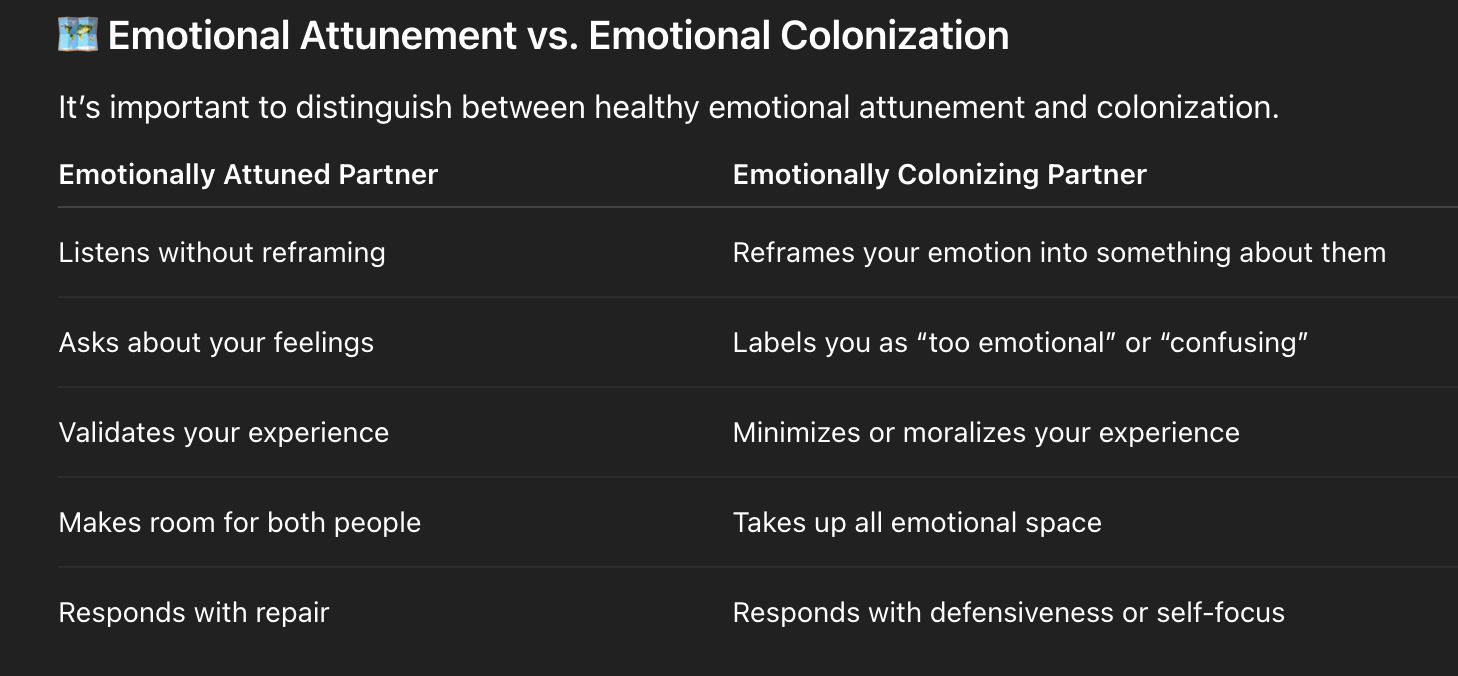
The difference is not intensity. The difference is space. In attunement, both people exist. In colonization, one emotional world dominates.
What to Do When You Recognize It
1. Name It (Even Privately)
“This space is being taken over.”
“My feelings are being overridden.”
Clarity begins internally, not externally.
2. Reconnect to Your Internal Reference Point
Practice statements like:
“My emotional truth is valid even if it isn’t understood.”
“I am not unreasonable because I feel something.”
“Disagreement does not erase my experience.”
You are allowed to exist in your own emotional field.
3. Refuse to Over-Explain
Over-explaining is often a survival response. It attempts to win space through persuasion. Instead, practice staying rooted:
“I’m not going to debate whether I felt that.”
“I’m not looking for agreement. I’m naming my experience.”
You do not need permission to have feelings.
4. Create a Ritual of Reclamation
Write what you actually feel. Speak aloud what is true, even if no one else hears it.
Reclaiming your emotional land often begins privately before it becomes relationally visible.
Grounding Phrases for the Moment
If you want language for when it happens in real time, try:
“I’m noticing this conversation is becoming centered around your interpretation again. I’m going to step back.”
Or:
“I’m not willing to lose my voice to maintain emotional order.”
These statements are not attacks. They are boundary markers.
The Deeper Question
Emotional colonization doesn’t just raise the question:
“What’s happening to me?”
It raises a deeper one:
“How do I take my inner land back?”
And that is not rebellion. It is restoration. You are not asking to dominate. You are asking to exist, and that is a holy thing.
Case Studies: Emotional Colonization in Real Life
Case Study 1: Sarah — “It Always Turns Into His Feelings”
Sarah and Daniel had been married for twelve years. Daniel described himself as emotionally expressive and deeply sensitive. When Sarah brought up concerns—about feeling lonely, overwhelmed, or unheard—Daniel often became visibly distressed.
He would say things like:
“I can’t believe you see me that way.”
“That really hurts to hear.”
“Now I feel like I’m failing you.”
Within minutes, the conversation shifted. Sarah found herself reassuring him, clarifying that she didn’t mean to attack him, softening her tone, and eventually abandoning her original point.
Daniel wasn’t shouting. He wasn’t cruel. He was wounded.
But over time, Sarah realized something: every time she tried to speak, she ended up stabilizing him. Her pain was real, but it could never stay in the center for long. She began to feel confused and exhausted. Eventually, she stopped bringing things up at all. The colonization wasn’t loud. It was gravitational.
Case Study 2: Mark — “I Just Need to Feel Chosen”
Mark frequently told his wife, Leah, that he needed reassurance. He asked if she still loved him, if she found him attractive, if she appreciated him enough.
Leah initially responded with empathy. But over time, the requests became constant. If she was tired or distracted, Mark interpreted it as rejection. If she set a boundary, he withdrew or became visibly anxious.
Conversations often sounded like:
“Why don’t you care about how I feel?”
“You know I struggle with this.”
“I just need you to show up better.”
Leah began monitoring her tone, her timing, even her facial expressions. She felt responsible for keeping Mark emotionally steady. Mark believed he was being vulnerable. And in some ways, he was, but his vulnerability required Leah to regulate him continuously. Her own internal world slowly shrank to accommodate his. The emotional space was no longer shared—it was managed.
Case Study 3: Emily — “You’re Too Emotional”
In this relationship, the colonization looked different. When Emily expressed sadness or frustration, her partner, Fred, responded with analysis rather than empathy.
“You’re overthinking this.”
“That’s not what happened.”
“You always interpret things negatively.”
Fred stayed calm and logical. Emily felt destabilized. Instead of her emotions taking over the space, they were subtly erased. The emotional center of gravity was Fred’s interpretation of reality. Over time, Emily began doubting herself:
“Maybe I am too sensitive.”
“Maybe I misunderstand everything.”
Fred didn’t explode, he reframed, but the effect was the same: Emily’s emotional ground disappeared.
Case Study 4: Rachel — The Spiritualized Version
Rachel and Andrew shared a strong Christian faith. When Rachel named relational harm, Andrew often responded with spiritual language.
“We need to extend grace.”
“You’re focusing too much on feelings.”
“Marriage is about endurance.”
When Rachel persisted, Andrew would express how discouraged he felt by her dissatisfaction. Rachel began to feel like her truth was unspiritual. Her emotional clarity felt like disloyalty. Andrew’s emotional world—his interpretation, his theology, his distress—became the organizing center. Rachel stopped speaking openly, not because she had no voice, but because using it felt morally dangerous.
Case Study 5: Laura — The Subtle Collapse
Laura did not argue. She collapsed. When her husband named something difficult, Laura became tearful and overwhelmed. She often said:
“I can’t handle this.”
“This is too much.”
“You’re making me feel attacked.”
Her husband would immediately back off, soften, and reassure. Laura wasn’t trying to dominate the space. She was afraid, but over time, repair became impossible because her distress halted every hard conversation. Her emotional state unconsciously dictated what could and could not be discussed. The marriage adjusted around her fragility, that, too, is emotional colonization.
What These Cases Have in Common
One emotional world becomes central.
The other person adapts.
Truth either gets redirected, analyzed, or silenced.
Regulation becomes one-sided.
Fatigue accumulates quietly.
No one needs to be cruel for colonization to occur. It is about space, not volume.
The Core Injury
Emotional colonization does not always feel like an attack. It feels like disappearing, and often the colonizing partner believes they are simply being honest, sensitive, or vulnerable. The issue is not emotion. The issue is emotional dominance without shared responsibility.
